
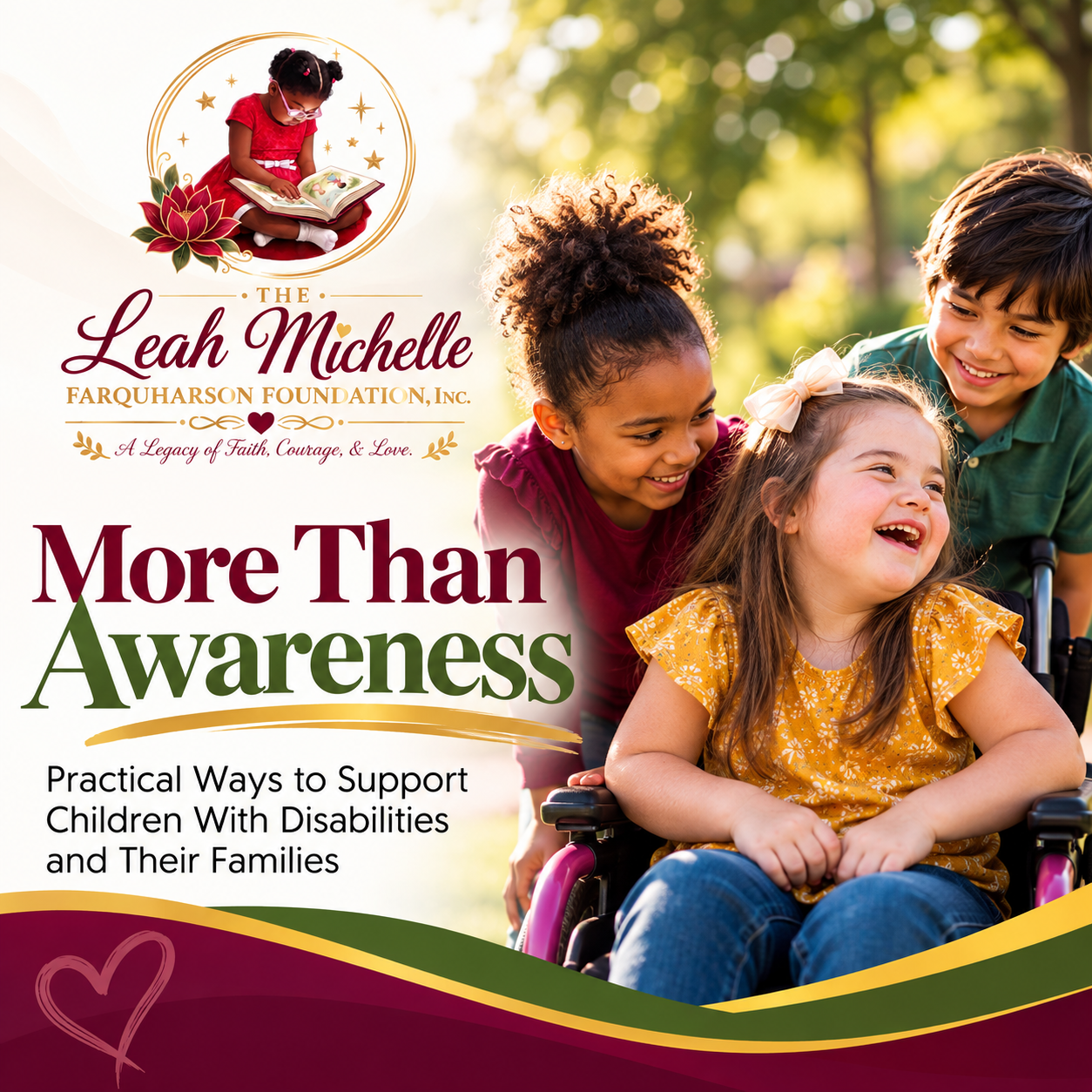
Supporting children with disabilities and their families requires more than awareness. It requires inclusion, understanding, accessibility, and communities willing to turn compassion into meaningful action.
Every child deserves opportunities to learn, participate, build relationships, and feel that they belong. Yet children with disabilities and their families may encounter barriers that other families do not—from inaccessible activities and environments to misunderstanding, isolation, and a lack of appropriate community support.
At the Leah Michelle Foundation, we believe stronger communities are created when children and families are welcomed, valued, and supported.
The good news is that making a difference does not always require a large program or financial contribution. There are practical ways individuals, families, schools, churches, nonprofits, and community organizations can help create more inclusive environments for children of all abilities.
1. See the Child, Not Just the Disability
One of the most important ways to support children with disabilities is also one of the simplest: get to know the child.
A disability may be part of a child’s life, but it does not define everything about that child.
Children have personalities, talents, interests, preferences, dreams, frustrations, and strengths. Ask what they enjoy. Learn what makes them laugh. Celebrate their accomplishments and give them opportunities to express themselves.
Whenever appropriate, communicate directly with the child rather than automatically directing every question to a parent, caregiver, or support person.
Inclusion starts with recognizing the whole person.
2. Listen to Parents and Caregivers
Parents and caregivers often have valuable insight into their child’s communication style, routines, strengths, accommodations, preferences, and support needs.
Instead of assuming what a family needs, ask.
A simple question such as “What would be most helpful?” can open the door to meaningful support without making assumptions.
Parents and caregivers may already spend considerable time explaining their child’s needs to schools, healthcare professionals, relatives, programs, and community organizations. Listening respectfully—and without immediately offering unsolicited advice—can make those interactions much more supportive.
Sometimes families aren’t looking for someone to solve a problem.
Sometimes they need someone willing to listen.
3. Create More Inclusive Community Activities
True disability inclusion means going beyond simply inviting everyone. We must also consider whether everyone has a reasonable opportunity to participate.
Schools, churches, nonprofits, recreational programs, community organizations, and event planners can ask:
- Is the location physically accessible?
- Are instructions and event information easy to understand?
- Can reasonable accommodations be made when needed?
- Is there a quieter area for children who may become overwhelmed by noise or crowds?
- Can activities be adapted for children with different abilities?
- Have families received enough information beforehand to determine whether the activity meets their child’s needs?
Small changes can sometimes remove significant barriers.
Accessibility should not be something considered after an event or program has already been created. Whenever possible, it should be incorporated into planning from the beginning.
4. Remember That Families Need Support Too
When we talk about supporting children with disabilities, we should also recognize the experiences of parents, caregivers, siblings, and other family members.
Families may be balancing school meetings, healthcare appointments, therapies, work responsibilities, transportation, finances, household responsibilities, and everyday family life.
Support doesn’t always have to be complicated.
It might mean:
- Checking in with a parent or caregiver
- Bringing a meal during a particularly demanding week
- Helping with transportation when appropriate
- Including siblings in activities
- Sharing a reliable community resource
- Continuing to extend invitations even when a family has previously had to decline
That last point matters.
A family may want to participate but face logistical or accessibility challenges that make participation difficult. Don’t automatically interpret a previous “no” as a desire not to be included.
Keep the door open.
5. Teach Children About Disability and Inclusion
Children naturally notice differences.
Adults have an opportunity to help them understand those differences with empathy and respect rather than fear or avoidance.
Age-appropriate conversations about disability can reinforce an important message:
People communicate, learn, move, play, and experience the world in different ways—and everyone deserves dignity and respect.
Children can also learn what inclusion looks like in everyday situations.
Encourage them to invite the child who is standing alone.
Teach patience when someone communicates differently.
Explain why it isn’t appropriate to make fun of assistive devices, physical differences, or behaviors they may not understand.
Teach children to ask before helping rather than assuming another child cannot do something independently.
Most importantly, demonstrate these behaviors yourself.
Children learn inclusion not only from what adults tell them, but also from what they see adults do.
6. Don’t Assume Every Disability Is Visible
Not all disabilities are immediately apparent.
Children may have developmental, intellectual, sensory, neurological, learning, or other disabilities and support needs that aren’t obvious to someone observing them.
A behavior that appears unusual may have an explanation you cannot see.
A parent handling a situation differently than you would may know something about their child’s needs that you don’t.
This is where compassion becomes especially important.
Before judging a child, parent, or caregiver during a difficult moment, remember:
You may not know the entire story.
Patience and kindness cost very little, but they can significantly change how welcomed a family feels in a community.
7. Ask Before Offering Help
The desire to help is positive. However, respectful support should preserve a person’s independence, dignity, and ability to make choices.
Instead of immediately stepping in, ask:
“Would you like some help?”
If the answer is yes, listen to how the person would like to be assisted.
If the answer is no, respect that answer.
Children with disabilities should be given opportunities to develop independence and participate to the extent appropriate for them.
Support should empower—not unnecessarily take control away.
8. Support the Caregivers Who Support Children
Caregiver support is an important part of building stronger families.
Parents and caregivers can devote significant time and energy to advocating, coordinating services, attending appointments, managing routines, and supporting their child’s development.
Community members can help by remembering the caregiver as a person, too.
Ask how they are doing.
Include them socially.
Celebrate their accomplishments.
Offer practical assistance when appropriate.
And avoid assuming they must always be strong.
A compassionate community supports both children and the people caring for them.
9. Support Organizations Creating Inclusive Communities
Individuals aren’t the only ones who can make a difference.
Nonprofits, schools, community organizations, faith communities, advocates, family groups, and service providers can play important roles in supporting children with disabilities and their families.
Community members can strengthen this work by:
- Volunteering time or professional skills
- Donating needed supplies
- Sharing reliable resources
- Supporting accessible community events
- Becoming community partners
- Helping families discover available programs
- Advocating for inclusive spaces
- Sharing accurate educational information
You don’t have to do everything.
Choose one meaningful way to contribute and start there.
From Disability Awareness to Meaningful Inclusion
Disability awareness is valuable because it can begin conversations.
But awareness should be the beginning—not the destination.
Meaningful inclusion happens when what we learn influences what we do.
We can listen more carefully.
We can design more accessible activities.
We can challenge assumptions.
We can support parents and caregivers.
We can teach children empathy.
We can continue extending invitations.
And we can create communities where children with different abilities have opportunities to participate, contribute, build relationships, and thrive.
At the Leah Michelle Foundation, we believe meaningful change often begins with ordinary people choosing to care and then turning that compassion into action.
Because every child deserves more than awareness. Every child deserves to belong.
Help Us Build a More Inclusive Community
The Leah Michelle Foundation is committed to supporting children, families, and communities through education, outreach, awareness, and meaningful community engagement.
Follow the Leah Michelle Foundation to discover educational resources, community initiatives, Foundation updates, volunteer opportunities, and ways to become involved.
Together, we can help create communities where more children and families feel seen, supported, and included.
A Legacy of Faith, Courage, & Love.